I build the machinery behind revenue.
Lead capture, enrichment, scoring and outreach, wired into systems that your team can read, trust and improve. I start from the sales goal and work back to the tooling.
GTM systems, built end to end.
Open a project to see the problem, the system I designed, and how it was actually built.
01
Inbound lead capture & reply
HubSpot + Make + Claude + Clay
Problem
When a lead reaches out, speed matters. But a fast reply that promises something nobody approved can do more damage than no reply at all. So I built an inbound engine that's fast and trustworthy, from the ground up rather than just configured from a template.
System
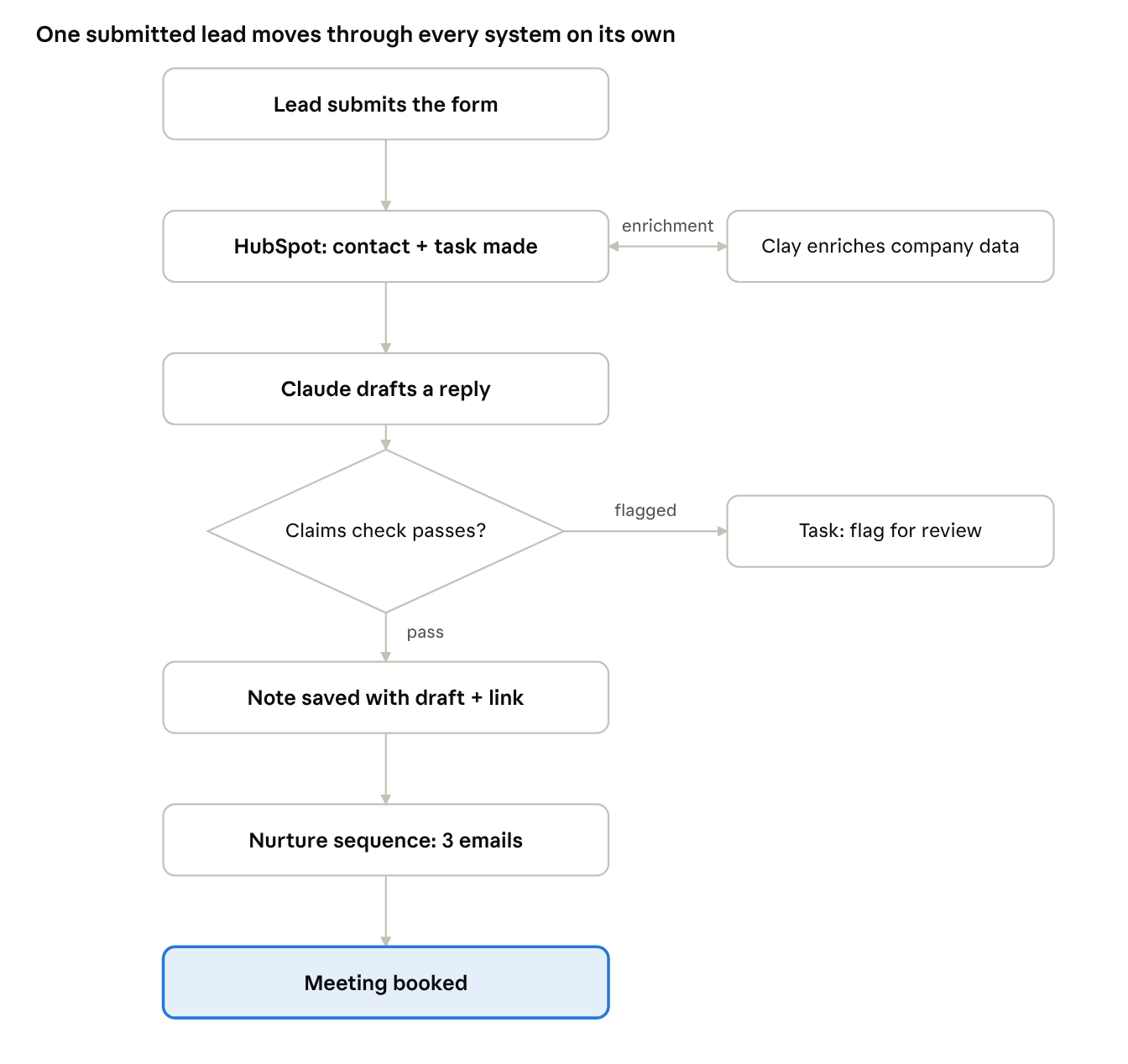
A form and landing page in HubSpot feed a native workflow that creates a follow-up task. A scenario calls Claude directly to draft a reply, then a second, independent Claude call checks that draft against a written claims policy before it's saved, and flags anything it doesn't trust instead of sending it quietly. Clay enriches the contact with real company data and writes it back to HubSpot. If a lead goes quiet, a three-email nurture sequence keeps following up, and every message carries a real HubSpot meeting link.
02
GTM Brain: account research system
Clay + Claude Code + Account Research
Problem
Most GTM teams decide who to sell to from gut feel. Account research is manual and inconsistent, with no single place holding a company's ICP, buyer personas and the triggers that actually mean it's worth a conversation.
System
I built a company-context system that connects a company's own profile, its ideal customer profile, buyer personas and brand signal into one research brief. That brief turns into explicit account search filters, Clay enriches and qualifies the resulting shortlist, and every account comes back with its fit reasoning and sources attached. You get a prioritized, evidence-backed shortlist instead of a guess.
03
Next case study
In progress
Currently building the next one. In the meantime, I'm posting the day-to-day GTM engineering learning journey, and keeping build notes on the GTM Builder Field Manual.
The value isn't in the tools you use.
Good GTM systems don't come from stacking apps together. They come from making the right call at each step.
Start with the objective
What does the business need to achieve, and by when?
Read the conditions
Budget, team, data and timeline decide what is realistic.
Design the strategy
ICP, segments, buyer and qualification rules.
Design the motion
Signals, channels, messages and handoffs.
Engineer the system
Data, automation, agents and human checkpoints.
Run and improve
Read the real output and tighten the system.

Revenue is the goal.The system is the craft.
I'm Smith, a GTM engineer trained through GTM Engineer School. I build the systems behind revenue: inbound and outbound capture, account research, enrichment, and the agentic workflows that tie them all together for early-stage teams. I start by understanding what the business actually sells and who it's for, then I design the system around that.
The systems I've built show how I approach the work. If any part of that sounds like what your team is dealing with right now, I'd love to hear about it.
See the systems I've built ↗